


Mobile DC charging station ECOES MultiCharger
DC fast charging up to 100 kW for cars, trucks, buses and tractors – where there are no charging stations. On a trailer or a truck, with a vending zone, a WC and payment by card or QR code.
- DC fast charging
- 100 kW
- vehicles at the same time
- 1 – 3
- operation in any climate
- −35 … +45 °C
- AC power for buildings and sites
- 230/400 V
I. What is the ECOES MultiCharger
The ECOES MultiCharger is a complex, independent engineering installation that produces AC/DC electricity for charging electric vehicles and other sites, within the single cloud ecosystem of ECOES Franchise for remote monitoring and support.
The ECOES installation is a MultiCharger, because:
It can charge all kinds of cars, trucks, buses, tractors and other mobile machines with electric motors with DC electricity.
It can perform DC fast charging up to 100 kW for one, two or three vehicles (1 x 100 kW, 2 x 50 kW, 3 x 33.3 kW).
It can charge electric vehicles and other sites in any climate, from −35 to +45 degrees Celsius.
It works equally well with any infrastructure – in the city, on the highway, in the desert, in the jungle and anywhere else.
It can be mounted on a truck to move on its own, or be towed on a trailer by a pickup or an SUV with a B+E licence.
It can work as a mobile or stationary DC charging station for vehicles, producing its own AC electricity or taking AC power from the grid.
It can produce electricity and supply 230/400 V AC to buildings, machines or other sites during power cuts or in remote places without a power supply.
The same machine can supply AC at 50 Hz and 60 Hz through a 60/50 Hz converter. The generator can be ordered to meet emission standard EU Stage II/III or EU Stage V.
It can run continuously or in standby, charging electric vehicles with DC or supplying AC power to buildings, machines or other sites.
It can take payments by card or QR code on its own and issue receipts and invoices to customers, with no operator or accountant involved.
It can offer customers everyday services: mobile vending machines for hot and cold drinks and snacks, a WC and a washbasin with hot and cold water.
On its own or in a network with other chargers, it can be monitored, diagnosed and configured remotely through the single cloud ecosystem of ECOES Franchise.
II. Why the ECOES MultiCharger
Because the future belongs to electric cars, and there will be more and more of them. That means more and more charging stations. Charging stations are built where there is enough electricity – in cities and at certain points of the existing road network. On roads in remote and intercity areas there is not enough electricity for charging stations, and such places far outnumber those that have it. That is why the task of the ECOES MultiCharger mobile charging stations is not to compete with stationary charging stations, but to fill the gap where there are none, and where there never will be without enough electricity.
DC electricity from mobile fast-charging stations sells at a higher price than at stationary charging stations, and that is logical, because power from the grid is much cheaper. Customers see and hear the generator of the ECOES MultiCharger running on expensive diesel, and accept the higher charging price with understanding. Charging in remote areas where there are no other charging stations, the ECOES MultiCharger does not really sell electricity: it sells the security and peace of mind that the cars will reach their destination.
A great advantage of the ECOES MultiCharger is its mobility. The franchisee watches the traffic and positions the charging stations in different places, wherever they will bring the most revenue.
The customer service zone brings additional revenue. A car charges for about 30 minutes on average. Meanwhile the driver and the waiting passengers are sure customers for the WC and for water, coffee, packaged snacks, energy drinks and more. Other petrol and diesel cars that do not need charging will also stop for the WC, coffee, water and other products. In this way the customer service zone generates about 20% additional revenue on top of the revenue from charging.
III. Construction and mobility
Construction
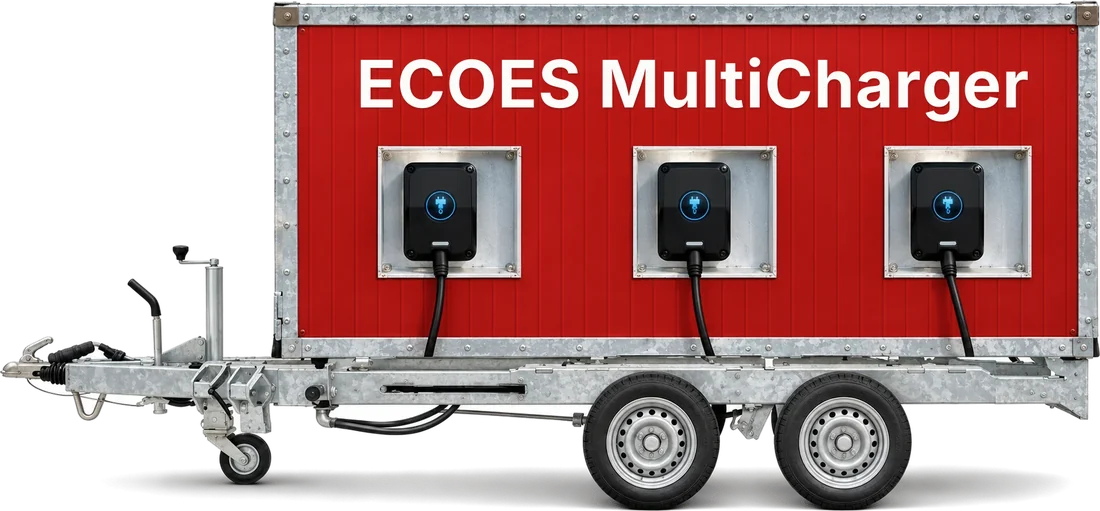
The ECOES MultiCharger is housed in a specially designed and certified mobile container, divided into three sections:
Power section – includes a diesel generator AC 400 V 50/60 Hz, 100 kW, 3 DC fast chargers 400 V – 800 V (1 x 100 kW, 2 x 50 kW, 3 x 33.3 kW), DC energy meters (MID), cloud billing accepting POS payments by debit/credit card and QR code, an invoicing system, and hardware for remote monitoring, configuration and service of the charging station.
Customer service section – includes vending machines for coffee, tea and other hot drinks, a vending machine for packaged food and cold drinks – water, soft drinks and energy drinks, folding tables, chairs and umbrellas, and a WC with a washbasin with hot and cold water. Cloud billing accepting POS payments by debit/credit card and QR code for the products consumed. A LiFePO4 battery system with an inverter powers the vending machines.
Operator’s section – includes a separate room with a bed, a desk with a chair, a locker for personal belongings, storage cabinets for vending products and a Wi-Fi connection. The operator does not handle money. All payments for charging and for customer services go through the payment system of ECOES Franchise, through which the money goes straight into the franchisee’s bank account.


The operator’s task is to assist customers while their cars charge, to protect the charging station against damage to the vending machines and theft of products, to keep it clean after use, and to keep in touch with the franchisee and the dispatch centre of ECOES Franchise when service support is needed.
The inner and outer walls of the charging station’s container are made of three layers of thermal and sound insulation, 55 mm thick. LED lighting illuminates the area around the charging station. The vending machines and the DC chargers are protected by lockable waterproof shutters when the charging station is not in operation.
Mobility
The ECOES MultiCharger is a mobile installation that travels on a trailer with a gross weight of up to 3,500 kg. The main unit of the ECOES MultiCharger is the same whichever vehicle it is placed on.

Or on a truck with a gross weight of at least 7,000 kg.

A new or used truck for mounting the ECOES MultiCharger is supplied by the customer.
Mounting on a trailer has the following advantages:
- A much lower price, because no truck is bought
- The towing vehicle (a pickup, an SUV or another car) with a weight of up to 3,500 kg is driven with a category B licence.
- One towing car can move several ECOES MultiCharger units and do other jobs the rest of the time, while a truck stands idle.
- The trailer is bought as a ready, registered product, while a truck can only be registered after type approval.
Towing a trailer with a gross weight of 3,500 kg requires a category E licence, whether the towing vehicle is a pickup or a truck.
Road signs
Road signs matter, because cars will drive past the ECOES MultiCharger without realising that it offers what they need. That is why signs visible from afar must be placed at a suitable distance of 50–100 m in front of and behind the charging station, so that drivers notice the charging station and slow down to stop.
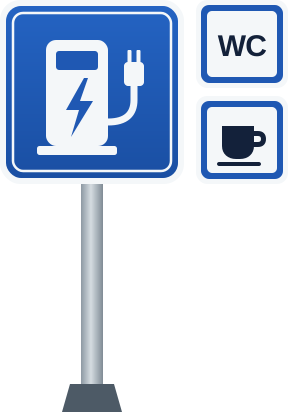
The ECOES MultiCharger comes with 2 road signs in the form shown above.
IV. Transport
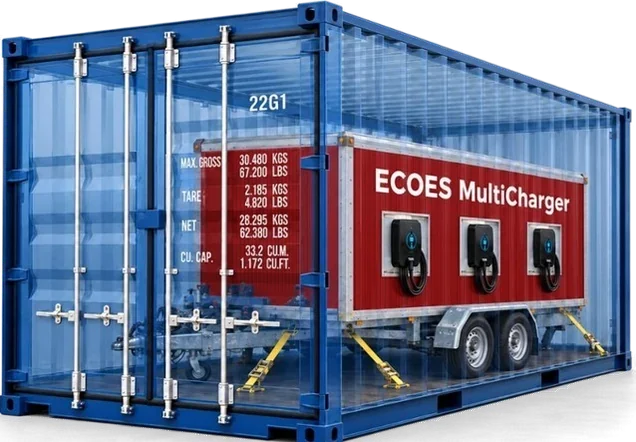
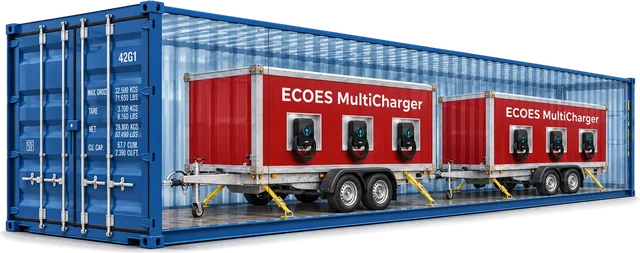
The ECOES MultiCharger is delivered to the customer by road, rail or sea in a standard 20 ft or 40 ft container.
V. Financial profitability of the ECOES MultiCharger
Main assumptions – average prices in Europe
- price of 1 kWh DC from the generator (0.3 L × 2.0 EUR/L)
- 0.60 EUR/kWh
- selling price in mobile mode
- 1.20 EUR/kWh
- selling price in stationary mode (grid power 0.30 EUR/kWh)
- 0.90 EUR/kWh
- gross profit per 1 kWh in both modes
- 0.60 EUR/kWh
1. Operating profitability in mobile mode
Stationary DC fast-charging stations powered from the grid sell electricity for charging electric cars at a price 2 – 2.5 times (200% – 250%) higher than the price at which they buy it from the energy suppliers. In this pricing the main factor is the price at which the electricity is bought. With the ECOES MultiCharger the price of the electricity produced depends on the price of the diesel that runs the diesel generator. The diesel consumption for producing 1 kWh of DC electricity, after deducting all mechanical and electrical losses, is 0.290 L/kWh (we take 0.3 L/kWh).
The price of diesel differs substantially between continents and countries. The average price of diesel in the fourth quarter of 2026 is 2.0 EUR/L incl. VAT in Europe, 1.66 USD/L (1.48 EUR/L) in North America, 1.50 USD/L (1.34 EUR/L) in Africa, 1.30 USD/L (1.16 EUR/L) in Latin America, and so on. Such large differences make it impossible to calculate a profitability valid for all countries. That is why we determine the profitability on the basis of diesel prices in Europe; for the other continents and countries the profitability will be proportional to the one calculated for Europe.
Since diesel for the generator accounts for about 90% – 95% of all costs, we determine the profitability from the fuel costs and the gross profit from selling DC fast-charging electricity. Revenue from serving customers at the vending machines also carries a mark-up of 2 – 2.5 times. We forecast the profitability of this activity in the range of 50 €/day to 200 €/day, depending on the commercial load (50 EUR/day at 25%, 100 EUR/day at 50%, 150 EUR/day at 75% and 200 EUR/day at 100% load).
With a consumption of 0.3 L/kWh for producing 1 kWh of DC fast-charging electricity and a diesel price of 2.0 EUR/L, the cost is 0.60 EUR/kWh (0.3 L/kWh x 2.0 EUR/L = 0.6 EUR/kWh). Applying the current rule that the selling price of DC fast-charging electricity is 2 – 2.5 times higher than the price at which the electricity is acquired, the selling price of electricity for cars comes to 1.20 EUR/kWh – 1.50 EUR/kWh. We do the calculations with the lower selling price of 1.20 EUR/kWh. At this price the gross profit from selling 1 kWh of DC fast-charging electricity is 0.60 EUR/kWh (1.20 EUR/kWh selling price – 0.60 EUR/kWh production cost = 0.60 EUR/kWh gross profit).
The price of 1.20 EUR/kWh for DC fast charging in Europe, when needed, is perfectly normal. It is not a price for everyday charging. It is a price for emergency charging from a diesel generator, when the car travels through remote areas where there is no power supply and no stationary charging stations.
2. Operating profitability in stationary mode
The ECOES MultiCharger can work in stationary mode wherever there is enough free AC electricity, 400 V, 100 kW. Such places are roadside restaurants, motels, petrol stations, car parks and others. Stationary operation has some advantages and disadvantages.
The advantages are that the diesel generator does not wear, there is no need to move from place to place, and a lower charging price can be offered while keeping the same gross profit. The disadvantages are that, without mobility, the ECOES MultiCharger cannot be positioned where the traffic is heaviest or in the remote places where a charging station is needed most. The profit from serving customers is lost, because a position next to an existing roadside business will take the customers away. And the franchisee depends on another party, who has to provide the electricity for the charging station in stationary mode.
Being able to work both mobile and stationary allows different modes or a mixed mode – for example, working in mobile mode in remote places during the day, and in stationary mode next to a roadside or city business in the evening.
The average price of electricity in Europe is about 0.30 EUR/kWh incl. VAT. This shows that electricity in stationary mode is half the price of electricity from the diesel generator (0.60 EUR/kWh). This difference makes it possible to lower the price for customers and keep the same gross profit, by setting the selling price at 3 times the price at which the electricity is bought. In this case the selling price of DC fast-charging electricity will be 0.90 EUR/kWh, keeping the gross profit at 0.60 EUR/kWh (0.90 EUR/kWh selling price – 0.30 EUR/kWh purchase price = 0.60 EUR/kWh gross profit).
The price of 0.90 EUR/kWh for DC fast charging in Europe, when needed, is perfectly normal. It is not a price for everyday charging. It is a price for emergency charging, when the car travels through remote areas where there are no stationary charging stations.
3. Determining the gross operating profit
The ECOES MultiCharger has a maximum DC fast-charging power of 100 kW.
In continuous 24-hour operation (100% load) we have 2,400 kWh/day of DC charging electricity (100 kW x 24 h = 2,400 kWh/day). The gross profit at 100% load is 1,440 EUR/day (100 kW x 24 h x 0.6 EUR/kWh = 1,440 EUR/day).
In real conditions it is not possible to work at 100% load. That is why the table below gives the gross profit from selling DC electricity at 10%, 25%, 50%, 75% and 100% load, plus the forecast profit from serving customers (25 EUR/day at 10%, 50 EUR/day at 25%, 100 EUR/day at 50%, 150 EUR/day at 75% and 200 EUR/day at 100% load).
24,600 EURgross profit per month
- per day
- 820 EUR
- per year (12 months)
- 295,200 EUR
- of which DC fast charging, per day
- 720 EUR
- customer service (forecast), per day
- 100 EUR
| Load | From DC fast charging of cars | From customer service (forecast value) | Total gross profit per day | Total gross profit per month | Annual gross profit (12 months) |
|---|---|---|---|---|---|
| at 10% | 144.00 | 25.00 | 169.00 | 5,070.00 | 60,840.00 |
| at 25% | 360.00 | 50.00 | 410.00 | 12,300.00 | 147,600.00 |
| at 50% | 720.00 | 100.00 | 820.00 | 24,600.00 | 295,200.00 |
| at 75% | 1,080.00 | 150.00 | 1,230.00 | 36,900.00 | 442,800.00 |
| at 100% | 1,440.00 | 200.00 | 1,640.00 | 49,200.00 | 590,400.00 |
Swipe the table sideways to see all columns.
DC fast chargingCustomer serviceEUR a month
Load
The table shows that just 10% load of the ECOES MultiCharger generates enough profit to pay a lease or a loan for buying it, while still leaving a profit for the franchisee. At normal loads in the range of 50% – 75%, very substantial profits are generated.
4. Net profit
To arrive at the net profit for the franchisee, the operating costs and the taxes of the country concerned must be deducted from the gross profit.
The figures given are indicative, but very close to the real values. They show the economic efficiency of the ECOES MultiCharger clearly enough when only one machine is used. Building a network of 5, 10 or more ECOES MultiCharger charging stations multiplies the financial results shown in the table many times over.
5. Investment profitability
Investment profitability is the ratio of the investment made to the operating return that pays it back.
To determine the investment profitability of the ECOES MultiCharger project, we compare the investment and the operating return with another kind of mobile equipment – a new three-axle EURO 6 tractor unit with a new three-axle semi-trailer, compared with the ECOES MultiCharger. The price of one new tractor unit is comparable to the price of two ECOES MultiCharger charging stations.
Price
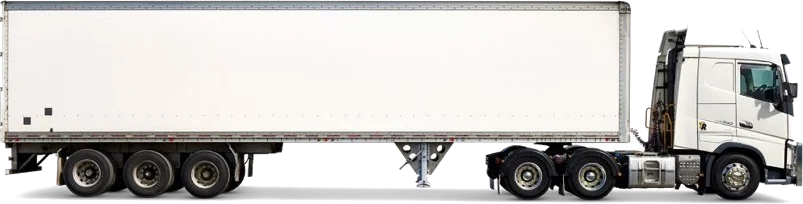
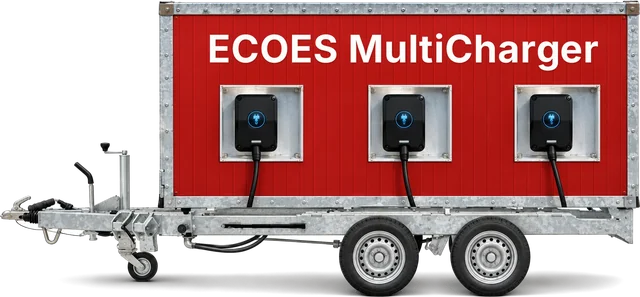
At 100% operating load the gross profit is about 3,000.00 EUR a month
The investment pays back in about 7 years.
At 50% operating load the gross profit is about 49,200.00 EUR a month
(2 pcs × 24,600.00 EUR = 49,200.00 EUR)
The investment pays back in about 5 months.
Announcements
- Sales of the ECOES MultiCharger will begin in 2027, following the completion of the certification process. Given the high level of interest – and to ensure accurate quantity planning – we are accepting pre-orders via the following form:
Pre-order form
- Submitting a pre-order is for planning purposes only. It carries no obligation to purchase or make a payment.
- Orders for delivery in 2027 will be exempt from the onboarding fee for the ECOES Franchise remote ecosystem.